The honey-loving bear from the Hundred Acre Wood is more than just a character; he's a cultural phenomenon, a comforting presence across generations. But have you ever stopped to truly look at Winnie the Pooh? His iconic silhouette, friendly face, and even his signature red shirt haven't always been the same. Tracing the History & Evolution of Winnie the Pooh Design reveals a fascinating journey from pen-and-ink whimsy to global brand icon, reflecting changing artistic styles, technological advancements, and shifts in audience expectations. It's a tale of how a beloved bear adapted, yet always retained his essential, lovable self.
At a Glance: Pooh's Enduring Design Journey
- Original Vision: E.H. Shepard's detailed, gentle illustrations defined Pooh's initial look, capturing A.A. Milne's literary world.
- Early Merchandise: Figurines from the 1930s, like Royal Doulton's, faithfully translated Shepard's classic aesthetic into three dimensions.
- Disneyfication: Walt Disney Productions acquired rights in the 1960s, introducing the now-famous red shirt, simplified forms, and animated expressions for a broader, global audience.
- Modern Adaptations: From stylized "Tsum Tsum" figures to minimalist interpretations and various animated series, Pooh's design continues to evolve, balancing tradition with contemporary appeal.
- Consistent Core: Despite visual changes, the fundamental warmth, innocence, and cuddly nature of Winnie the Pooh remain central to every design.
The Bear Behind the Books: A.A. Milne's Hundred Acre Inspiration
Long before he was a global merchandising powerhouse, Winnie the Pooh was a cherished character in stories told by British author A.A. Milne to his son, Christopher Robin. The actual bear who inspired the name was a friendly black bear cub named Winnipeg ("Winnie") at the London Zoo, which Christopher Robin often visited. His own teddy bear, originally named Edward, was renamed Winnie the Pooh, combining the zoo bear's name with a swan Christopher Robin had met.
Milne's published collections, Winnie-the-Pooh (1926) and The House at Pooh Corner (1928), laid the literary foundation. But it was the artistry accompanying these tales that first gave Pooh his visual identity.
E.H. Shepard's Enduring Masterpiece: The Birth of Classic Pooh
The true original designer of Winnie the Pooh, in the purest sense, was illustrator E.H. Shepard. His pen-and-ink drawings, often with delicate washes of color, brought the inhabitants of the Hundred Acre Wood to life with a timeless charm. Shepard's Pooh was a rather simple, slightly lumpy teddy bear, often depicted without clothes or perhaps in a loose, undefined garment. He had a gentle, somewhat naive expression, with a small nose and distinctively drawn eyes.
Shepard's style was characterized by:
- Understated Elegance: Not overly expressive or cartoonish, but capturing emotion through subtle posture and line work.
- Detailed Environments: The Hundred Acre Wood felt real and inviting through his intricate backgrounds.
- A "Toy" Quality: Pooh and his friends looked like actual beloved stuffed animals, worn from affection.
This "Classic Pooh" style, synonymous with Shepard's illustrations, set the benchmark for all future interpretations. Its enduring appeal meant that early merchandise sought to replicate its faithful charm. In the 1930s, the English company Royal Doulton produced some of the earliest Winnie the Pooh figurines. These ceramic pieces meticulously captured Shepard's style, often depicting Pooh in that friendly, lovable nature defined by the original drawings. Collectors still highly prize these pieces for their intricate detailing and hand-painted accents, a testament to the timeless beauty of Shepard's vision.
From Bookshelves to Beyond: The Early Days of Merchandising
The popularity of Milne's books quickly led to a demand for merchandise. In 1930, American producer Stephen Slesinger acquired the exclusive merchandising and other rights to Winnie the Pooh for the United States and Canada. This was a pivotal moment, taking Pooh beyond the pages and into a wider commercial sphere. Slesinger's efforts expanded the character's reach, leading to various formats of merchandise, from toys to games. While still largely based on Shepard's aesthetic, this era began the slow transformation of Pooh from literary character to marketable icon.
Disney's Defining Chapter: The Red Shirt Revolution
The most significant inflection point in the History & Evolution of Winnie the Pooh Design occurred in 1961 when Walt Disney Productions acquired the licensing rights from Slesinger's widow. Walt Disney's daughters were fans, and the studio saw immense potential.
Disney's adaptation, beginning with the animated short Winnie the Pooh and the Honey Tree in 1966, introduced a drastically different, yet equally beloved, visual style. This was the birth of the "Disney Pooh" that most people recognize today.
Key changes introduced by Disney included:
- The Iconic Red Shirt: Perhaps the most enduring design alteration, Pooh gained his signature, slightly too-small red shirt. This instantly recognizable garment became a brand staple.
- Rounded and Simplified Forms: Disney artists smoothed out Shepard's slightly lumpy Pooh, giving him a more consistently rounded, soft, and huggable appearance, ideal for animation. His head became larger in proportion to his body.
- Expressive Features: Pooh's eyes became larger and more open, and his mouth more adaptable to convey a wider range of animated emotions, from confusion to pure joy.
- Animation-Ready Appeal: Every design choice was geared towards making Pooh (and his friends) vibrant and dynamic on screen, easily translating into a franchise of movies, TV shows, and theme park attractions.
This Disney iteration cemented Winnie the Pooh's place as a global phenomenon. The design was instantly appealing, easily reproducible across various media, and projected a warm, optimistic innocence that resonated with audiences worldwide.
The Modern Era: Stylization, Simplification, and New Interpretations
The Disney design became the baseline, but it hasn't stood still. The Evolution of Winnie the Pooh Design continued to unfold, adapting to new trends, technologies, and target demographics while always maintaining the character's core identity.
Modern Winnie the Pooh figurines and designs often feature a more stylized or cartoonish appearance. These interpretations might have:
- Exaggerated Features: Even larger heads or rounder bodies, pushing the "cuddly" factor even further.
- Simplified Details: Reducing intricate lines to broader shapes, making them pop in digital animation or on smaller screens.
- Material-Specific Adaptations: Designs tailored for plush toys (soft, squeezable forms), digital games (cleaner lines for rendering), or collectible figures.
Consider examples like the "Tsum Tsum" series produced by Disney. These stackable, oval-shaped plush toys feature a highly simplified, stylized design of Pooh and his friends, reducing them to their most basic, recognizable forms. They are playful and collectible, appealing to a different aesthetic preference than the classic porcelain figures. On the other hand, the Leblon Delienne series showcases a more realistic yet minimalist design, offering a sophisticated, art-toy interpretation that balances recognizability with sleek, contemporary style.
Across various animated series and films, from The New Adventures of Winnie the Pooh to the live-action Christopher Robin movie, artists have subtly tweaked Pooh's look to fit the medium and storytelling needs. Each iteration seeks to capture the lovable and endearing nature of the character, whether through classic artistry or modern digital rendering.
Why Design Choices Matter: Connecting Generations
The continuous evolution of Winnie the Pooh's design isn't just about superficial changes; it's about relevance and connection.
- Accessibility: Modern, simplified designs can be more universally appealing, especially to younger children who are encountering Pooh for the first time.
- Brand Longevity: Adapting the design ensures Pooh remains fresh and engaging in an ever-changing media landscape, preventing him from feeling dated.
- Merchandising Versatility: Different designs open up new avenues for products, from high-end collectibles to mass-market toys and apparel.
- Nostalgia vs. Innovation: Each design iteration offers fans a touchpoint, whether they prefer the nostalgic "Classic Pooh" or the vibrant "Disney Pooh," or even newer, artistic interpretations.
The magic lies in how designers have managed to evolve Pooh's appearance without losing his essence. Whether he's a delicate pen-and-ink drawing, a chunky ceramic figurine, or a rounded animated character in a red shirt, he always projects warmth, innocence, and that endearing love for honey.
Navigating Pooh's Visual History: A Guide for Fans and Collectors
Understanding the different design eras can enrich your appreciation for Winnie the Pooh, especially if you're a collector or looking for specific styles.
- Shepard's Classic Pooh: Look for a more traditional, almost sketched quality. Pooh might be without a shirt or in a very simple, indistinct garment. His body is less uniformly round, with a softer, almost academic expression. These are often found in older books, limited edition prints, or high-end reproductions of the original art. You can often Explore vintage Winnie the Pooh items that showcase this timeless aesthetic.
- Early Disney Pooh (1960s-1980s): This is where the red shirt becomes standard. Pooh's body is more uniformly rounded, his eyes are larger and more expressive, and his overall look is softer and more explicitly "cartoon" like. This era includes the early animated shorts and films.
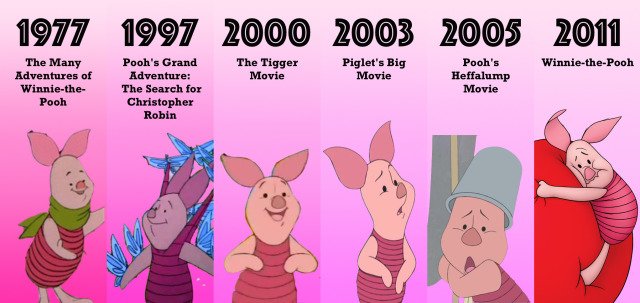
- Modern Disney Pooh (1990s-Present): While still recognizable as Disney Pooh, newer iterations might show subtle differences. Animation styles might make him slightly thinner, or his expressions might be more dynamic. Examples like the My Friends Tigger & Pooh series show him in CGI, which naturally brings a different texture and fluidity to his design. More extreme stylizations like the Tsum Tsum figures or the minimalist Leblon Delienne statues also fall into this category, pushing design boundaries while retaining brand identity.
Identifying these subtle shifts helps in understanding the broad tapestry of Winnie the Pooh's visual journey.
The Enduring Appeal: More Than Just a Design
Winnie the Pooh figurines, regardless of their specific design era, consistently capture the lovable and friendly nature of the character. Whether you prefer the intricate detailing of a vintage Royal Doulton piece, the cheerful simplicity of a Disney plush, or the contemporary flair of a stylized art figure, each piece is a testament to the enduring power of good design.
The journey of Winnie the Pooh's design, from the precise lines of E.H. Shepard to the dynamic shapes of Disney animation and the bold interpretations of modern artists, is a microcosm of character design itself. It showcases how fundamental elements can remain consistent even as outer forms adapt and evolve to speak to new audiences and new eras. It's a reminder that true magic isn't just in the first stroke of the pen, but in the countless ways that vision can be reimagined, refined, and lovingly brought to life over and over again.
Your Own Pooh Journey: Embracing the Ever-Evolving Bear
Whether you're decorating a nursery, adding to a cherished collection, or simply appreciating a piece of childhood, there's a Winnie the Pooh design out there that speaks to you. The evolution of his look is not about replacing the old with the new, but enriching the legacy. Each design iteration, whether classic or contemporary, contributes to the rich tapestry of Pooh's story, ensuring that this lovable bear and his friends will continue to capture hearts for generations to come. Why not delve deeper into the designs that resonate most with you, and perhaps add a piece of Pooh's evolving history to your own home? You'll be sure to bring a little bit of the Hundred Acre Wood's magic into your life.